AI in healthcare is not just a trend; it’s a transformative force reshaping how we approach medical diagnosis, treatment, and patient care. This technology is revolutionizing the way healthcare professionals make decisions, predict outcomes, and manage patient data, ultimately leading to improved health results.
With the integration of machine learning algorithms and data analytics, AI is enhancing our ability to provide personalized treatment plans and support, particularly in mental health and chronic disease management. As the healthcare landscape evolves, understanding the impact of AI becomes increasingly essential for both providers and patients.
AI Applications in Healthcare
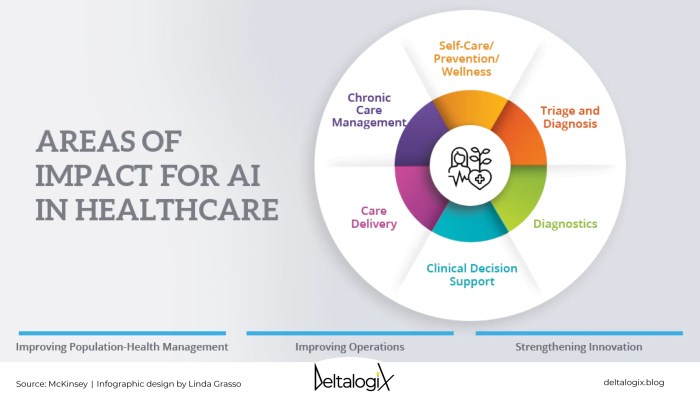
Artificial Intelligence (AI) is revolutionizing the healthcare sector by enhancing diagnostic accuracy, improving patient care, and optimizing clinical workflows. With its ability to analyze vast amounts of data, AI is not only assisting healthcare professionals but also empowering patients to take charge of their health like never before. The incorporation of AI technologies is setting new standards for patient management, ushering in an era of personalized medicine and predictive healthcare.
Transforming Diagnostics and Patient Care
AI technologies are making significant strides in the realm of diagnostics by providing tools that enhance the accuracy and speed of disease detection. For instance, deep learning algorithms are now used to analyze medical imaging, enabling radiologists to identify conditions such as tumors or fractures with greater precision. These AI-driven systems can process images faster than human experts, often detecting abnormalities that may go unnoticed.
A notable example is Google’s DeepMind, which has developed AI that can diagnose eye diseases from retinal scans with a level of accuracy comparable to that of human specialists. Such advancements not only lead to earlier interventions but also reduce the burden on healthcare professionals, allowing them to focus on more complex cases.In patient care, AI applications like virtual health assistants and chatbots are transforming how patients interact with healthcare providers.
These tools can manage appointments, provide medication reminders, and offer basic health advice, making healthcare more accessible and efficient.
Machine Learning in Predicting Health Outcomes
Machine learning, a subset of AI, plays a crucial role in predicting health outcomes by harnessing historical patient data to identify patterns and trends. By analyzing various factors such as demographics, medical history, and lifestyle choices, machine learning models can forecast potential health issues before they arise.For instance, hospitals use machine learning algorithms to predict patient readmission rates, which helps in devising strategies to improve post-discharge care.
A prominent case is Mount Sinai Health System, which implemented AI-driven tools to predict which patients were at risk of readmission within 30 days of discharge. This proactive approach led to a significant reduction in readmission rates, ultimately enhancing patient care and reducing costs.Machine learning also supports chronic disease management by predicting flare-ups in conditions such as diabetes and asthma.
By leveraging real-time data from wearable devices, healthcare providers can intervene early, thereby improving patient outcomes and quality of life.
Integration of AI with Electronic Health Records
The integration of AI with Electronic Health Records (EHRs) is enhancing patient management by streamlining data access and improving clinical decision-making. AI algorithms can analyze EHR data to provide healthcare professionals with actionable insights that inform treatment plans.For example, AI systems can flag potential drug interactions or suggest personalized treatment options based on a patient’s complete medical history. This not only enhances patient safety but also fosters a more tailored approach to healthcare.
Furthermore, AI-enabled predictive analytics can identify trends in patient populations, helping healthcare organizations allocate resources more efficiently.The use of AI in EHRs also facilitates better communication among healthcare teams. For instance, natural language processing can summarize patient notes, making it easier for clinicians to access essential information quickly. This level of integration ultimately leads to improved care coordination, reduced errors, and better patient outcomes.Overall, the application of AI in healthcare is proving to be a game-changer.
By enhancing diagnostics, predicting health outcomes, and integrating seamlessly with EHRs, AI is paving the way for a more efficient, effective, and patient-centered healthcare system.
AI in Mental Health Treatment

As mental health continues to gain recognition as a crucial aspect of overall wellness, the integration of artificial intelligence (AI) in treatment and monitoring is becoming increasingly relevant. AI technologies are opening new avenues for understanding and addressing mental health conditions, allowing for more personalized and timely interventions. By leveraging data and advanced algorithms, healthcare providers can offer enhanced support tailored to individual needs.AI can assist in mental health monitoring and therapy through various methods, enhancing both accessibility and effectiveness of treatment.
One key approach is through predictive analytics, which utilizes data from patient histories, behaviors, and responses to therapy to identify at-risk individuals. AI algorithms can analyze patterns in this data, enabling clinicians to intervene proactively before a crisis occurs. Additionally, natural language processing (NLP) tools can analyze patient conversations or written content to detect emotional distress or changes in mood.
These insights can help therapists adjust treatment plans and provide immediate support when necessary.
AI-driven Apps for Mental Health Support
The advent of AI-driven applications has transformed the mental health landscape, offering users valuable resources and support at their fingertips. These apps provide tools for self-monitoring, helping users track their moods, thoughts, and behaviors over time. They often incorporate techniques from cognitive behavioral therapy (CBT), mindfulness practices, and other therapeutic modalities, allowing users to engage in self-help exercises tailored to their specific needs.Some notable examples of AI-driven mental health apps include:
- Woebot: A chatbot designed to engage users in conversations about their feelings, providing support and coping strategies based on cognitive behavioral therapy.
- Wysa: An AI-powered mental health app that offers emotional support through chat, utilizing evidence-based therapeutic techniques to help users manage their mental health.
- Replika: An AI companion that learns from user interactions, providing conversation and support that adapts to the user’s emotional state.
These applications not only make mental health care more accessible but also serve as a bridge between patients and providers, facilitating ongoing communication and support.
Ethical Considerations in AI for Mental Health
While the benefits of AI in mental health treatment are significant, there are essential ethical considerations that must be addressed. One major concern is the protection of patient privacy. AI systems often require access to sensitive personal data, raising questions about data security and consent. Ensuring that this information is handled responsibly and transparently is crucial for maintaining trust in AI technologies.Another ethical issue is the potential for bias in AI algorithms.
If these systems are trained on non-representative data, they may perpetuate inequalities in mental health care, leading to suboptimal outcomes for certain populations. Continuous monitoring and adjustments to AI models are necessary to ensure fair and equitable treatment across diverse groups.Moreover, the role of human judgment in mental health care must not be overlooked. AI should augment, not replace, the empathic and nuanced understanding that human therapists provide.
Establishing clear guidelines on the appropriate integration of AI tools into clinical practice is essential for maximizing their benefits while safeguarding the integrity of mental health treatment.
AI and Personalized Medicine
The integration of Artificial Intelligence (AI) into personalized medicine marks a revolutionary shift in how healthcare is approached. By utilizing advanced algorithms and data analytics, AI can tailor medical treatment plans to individual patients based on a variety of factors, including genetic information, lifestyle choices, and environmental influences. This level of personalization offers the potential for more effective treatments, reduced side effects, and improved patient outcomes.AI-driven personalized medicine leverages genetic data to create comprehensive treatment strategies.
By analyzing an individual’s genomic information, algorithms can identify specific biomarkers that predict how a patient will respond to a particular medication or therapy. This framework allows healthcare providers to devise treatment plans that are not only more effective but also uniquely suited to each patient’s biology.
Framework for Personalizing Treatment Plans
The framework for utilizing AI in personalizing treatment plans based on genetic data involves several key components:
1. Data Collection
Gathering comprehensive genetic, clinical, and lifestyle data from patients through genomic sequencing and electronic health records (EHRs).
2. Data Analysis
Employing machine learning algorithms to analyze this data, identifying patterns and correlations that inform treatment options.
3. Predictive Modeling
Utilizing predictive analytics to forecast patient responses to different therapies, enabling the selection of the most promising treatment paths.
4. Implementation of Treatment
Delivering personalized treatment plans that take into consideration the individual patient’s genetic makeup, health history, and preferences.
5. Continuous Monitoring
Leveraging AI to monitor patient responses to treatment in real-time, allowing for adjustments as needed based on ongoing data analysis.
“The future of healthcare lies in understanding the unique genetic blueprint of each patient, allowing for truly personalized interventions.”
Implications of AI in Drug Discovery and Development
AI significantly accelerates the drug discovery and development process, which traditionally has been time-consuming and costly. By enhancing every phase of drug development, from initial screening to market release, AI reduces the time required to bring new therapies to patients.
Target Identification
AI algorithms can analyze vast amounts of biological data to identify new drug targets that may have been overlooked in traditional research.
Compound Screening
Machine learning models can predict the efficacy and safety of drug compounds, allowing researchers to focus on the most promising candidates early in the development process.
Clinical Trial Optimization
AI can assist in designing clinical trials by identifying suitable patient populations and optimal dosing regimens, improving the chances of successful outcomes.
Post-Market Surveillance
Once a drug is on the market, AI continues to play a role by monitoring real-world patient data to identify potential side effects or efficacy issues.
Comparison of Traditional Treatment Methods and AI-Enhanced Approaches in Chronic Disease Management
In chronic disease management, traditional treatment methods often follow a one-size-fits-all approach, with guided protocols based on average patient responses. In contrast, AI-enhanced approaches provide a more individualized framework for care.
Traditional Methods
Treatment plans are often standardized based on population studies, leading to variability in effectiveness among individuals.
AI-Enhanced Approaches
AI uses real-time data from wearables and health apps to generate personalized recommendations, which can adapt based on the patient’s daily health metrics.The comparison highlights the transformative potential of AI:| Aspect | Traditional Methods | AI-Enhanced Approaches ||—————————|——————————–|——————————|| Customization | Limited personalization | Highly tailored interventions || Data Utilization | Historical and static data | Real-time dynamic data || Feedback Loops | Infrequent adjustments | Continuous monitoring || Patient Engagement | Passive involvement | Active participation |
“AI in chronic disease management allows for a shift from reactive to proactive care, fundamentally changing how patients experience and manage their health.”
End of Discussion
In conclusion, the integration of AI into healthcare is not merely about efficiency; it’s about enhancing the quality of care delivered to patients. From diagnostics to personalized medicine, AI holds the promise to significantly improve health outcomes and support mental health initiatives, offering a glimpse into a future where technology and medicine work hand in hand.
FAQ Resource
What are the main benefits of AI in healthcare?
AI improves diagnostic accuracy, personalizes treatment plans, reduces administrative burdens, and enhances patient monitoring.
How does AI contribute to mental health treatment?
AI assists in monitoring patient progress through apps, providing tailored therapy suggestions, and ensuring timely interventions.
Are there risks associated with AI in healthcare?
Yes, there are concerns regarding data privacy, the potential for bias in algorithms, and the need for ethical considerations in treatment decisions.
Can AI replace healthcare professionals?
No, AI is meant to augment the capabilities of healthcare professionals, not replace them, by providing tools that enhance decision-making.
What is the future of AI in healthcare?
The future includes more advanced predictive analytics, broader integration into patient care systems, and continuous improvements in personalized medicine.